The Short Answer
The best audio gear in 2026 is not the product with the longest feature list. It is the pair of headphones, earbuds, or speakers that fits your listening environment, phone ecosystem, comfort needs, and tolerance for battery management. Active noise cancellation, lossless Bluetooth, LE Audio, Auracast, spatial audio, and AI call processing can all be useful, but only when the rest of the product is solid: fit, controls, app support, reliability, and sound you actually enjoy.
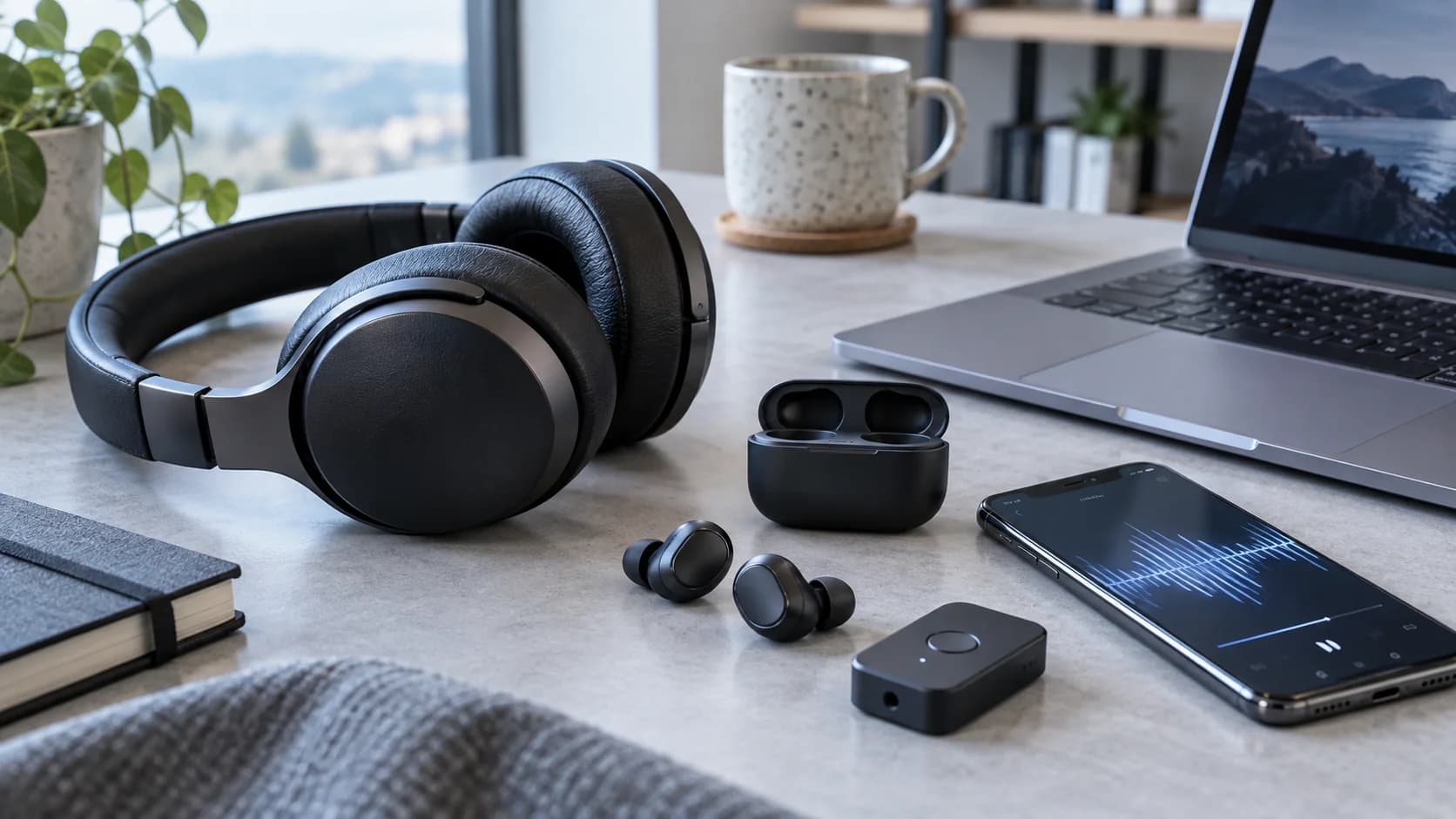
For most shoppers, the first choice is still format. Over-ear headphones are usually best for long listening, travel, desk work, and stronger noise cancellation. True wireless earbuds are better for commuting, workouts, pockets, and calls. Open-ear designs are useful when awareness matters. Portable Bluetooth speakers are a different purchase entirely, built around room sound and sharing. Start with use case, then compare technology. That order saves money.
Why Audio Feels More Complicated Now
Wireless audio has entered a phase where the small print matters. Sony's WH-1000XM6 specifications list Bluetooth 5.3, LDAC, LC3, multipoint connection, ambient sound mode, and up to 30 hours of music playback with noise canceling on. Qualcomm's Snapdragon Sound page emphasizes lossless, high-resolution, low-latency, and call-quality features. The Bluetooth SIG's LE Audio media kit describes LE Audio as the next generation of Bluetooth audio.
Those technologies can improve listening, but they do not work in isolation. A headphone can support an advanced codec while your phone does not. A laptop may fall back to a basic codec. A music service may not stream the format you expect. A noisy commute may make lossless audio less noticeable than stronger ANC. The spec sheet is useful, but the connection chain matters from source to ear.
ANC Is Still The Everyday Feature
Active noise cancellation remains the feature most people notice first because it changes daily life. Good ANC can make trains, planes, offices, coffee shops, and household noise feel less tiring. It does not erase every sound, and it usually works best on steady low-frequency noise rather than sudden voices or sharp sounds. Still, for travel and focus, ANC often matters more than high-resolution codec support.
Ambient or transparency modes are just as important. They let you hear announcements, traffic, coworkers, or family without removing the headphones. The best audio gear lets you move between isolation and awareness quickly. If a product buries that control in an app or makes the mode sound unnatural, it may become annoying. Convenience is part of sound quality when you use the product all day.
Lossless Bluetooth Needs The Right Chain
Lossless and high-resolution wireless audio are appealing, but shoppers should treat them as compatibility questions. Qualcomm says aptX Lossless is part of Snapdragon Sound and can scale based on link quality while preserving the original content when conditions allow. Its aptX technology page also explains that both the sending device and receiving device need support. That detail is easy to miss.
This means a premium pair of earbuds may not deliver its best codec on every phone, tablet, or laptop. Apple devices, Android phones, Windows laptops, and gaming handhelds can all differ in codec support. If you care deeply about lossless wireless listening, check your exact device, headphone model, music app, and settings before buying. If you mostly listen while walking outside, codec support may matter less than fit, wind handling, and stable connection.
LE Audio And Auracast Are The Future-Looking Features
LE Audio and Auracast are worth watching because they change how Bluetooth audio can be shared. The Bluetooth SIG's Auracast media kit describes broadcast audio as a way to share audio and improve listening experiences in public venues and assistive settings. Its Auracast product finder shows a growing list of receivers, transmitters, headphones, speakers, and venue hardware.
For shoppers, Auracast could eventually make it easier to hear airport announcements, gym TVs, museum audio, conference streams, or shared phone audio through compatible earbuds. But availability is uneven. A product saying Bluetooth 5.3 does not automatically mean every LE Audio or Auracast feature is active. Check the exact feature list. Future-ready is only useful when support is real.
Comfort Beats Specs In Long Sessions
Comfort is the underrated audio spec. Over-ear headphones can sound excellent and still fail if the clamp force hurts after an hour. Earbuds can have strong ANC and still be useless if the tips loosen during a walk. Open-ear designs can feel freeing but leak sound or lack bass for some listeners. Because ears and heads vary, reviews can only go so far. Return policies matter.
Weight, padding, heat buildup, ear-tip options, water resistance, and control placement all affect daily use. Sony lists the WH-1000XM6 at about 8.96 ounces, which gives shoppers one measurable comfort clue. Earbuds require a different checklist: tip sizes, stem or button controls, case pocketability, IP rating, and whether the microphone handles wind. A device you forget you are wearing often beats the one with the most advanced marketing.
Battery Numbers Need Context
Battery life claims are not equal. Some quote playback with ANC off, some quote ANC on, some quote case totals, and some include special modes that drain power faster. Sony's WH-1000XM6 page lists up to 30 hours with noise canceling on and 40 hours off. Earbuds often have shorter single-charge life but gain many extra hours through the case. A product used for flights, workdays, or sleep needs different endurance than a gym pair.
Charging convenience matters too. USB-C is common, but wireless charging, quick charging, and case battery indicators can change how often you think about power. For travel headphones, passive wired operation can be useful if the battery dies or an in-flight system needs a cable. For earbuds, replacement case cost and battery aging should factor into long-term value.
The Bottom Line
Audio gear in 2026 is better than ever, but it is also easier to overbuy. Choose over-ear headphones for comfort, travel, and strong ANC. Choose earbuds for portability, exercise, and calls. Choose open-ear designs for awareness. Choose codec-heavy products only when your phone or laptop supports the same technology. Look at LE Audio and Auracast as promising features, but confirm real support.
The smartest purchase is the product whose strengths match your routine. For some people that means the best ANC. For others it means secure fit, clearer calls, lower latency, or a speaker that makes the kitchen sound better. Specs are clues, not the final answer. Your listening life is the final answer.
Sources
- WH-1000XM6 Specifications
Sony | Checked
- Snapdragon Sound
Qualcomm | Checked
- Lossless Music
Qualcomm | Checked
- Experience High-Quality Audio with Qualcomm aptX
Qualcomm | Checked
- Bluetooth LE Audio media kit
Bluetooth SIG | Checked
- Auracast broadcast audio media kit
Bluetooth SIG | Checked
- Find an Auracast product
Bluetooth SIG | Checked
Editorial disclosure
This article was drafted by The Daily Unfold editorial desk using reviewed public specifications and technology sources. It is independent shopping guidance, not sponsored content, and it does not claim hands-on testing unless explicitly stated.