The Short Answer
Card games are having a practical 2026 moment because they solve three problems at once: people want lower-cost entertainment, shorter rules, and social experiences that do not require everyone to stare at a screen. That does not mean card games are replacing video games or long strategy nights. It means the center of casual tabletop play is shifting toward games that can be opened, explained, played, and replayed before the group loses momentum.
The trend is visible in both product pipelines and player behavior. Publishers are releasing compact party, travel, and family formats, while community trend lists show continuing interest in quick-play tabletop experiences. Exploding Kittens, one of the most visible casual card-game publishers, announced ten new games for summer 2026, positioning them around easy learning, travel readiness, and group play Exploding Kittens launch announcement. The broader playing cards and board games market is also expected to keep growing through the decade Grand View Research market report.
Why Card Games Fit 2026
The appeal of card games in 2026 is not nostalgia alone. It is format. A small deck can travel, fit on a coffee table, cost less than many boxed hobby games, and support flexible player counts. That makes card games useful for apartments, cafes, dorms, family gatherings, work socials, and trips where space is limited. The best modern card games also understand pacing. They build a clear loop, then let humor, bluffing, memory, timing, or luck create the story.
This matters because entertainment habits are fragmented. People often arrive at a game night with different attention spans, different levels of experience, and different tolerance for rules. A dense rulebook can stop the night before it starts. A fast card game lowers the entry barrier. The group can decide after one round whether to play again, switch games, or teach someone new. That flexibility is a major reason the category keeps expanding.
Fast Rules Matter
The strongest card games usually explain their promise quickly. Players should understand what they are collecting, avoiding, trading, stealing, guessing, matching, or surviving within minutes. That does not make the games shallow. In many cases, short rules create more room for table talk, bluffing, and memorable mistakes. The design challenge is to make the first turn obvious while still allowing the fifth playthrough to feel different.
The current product language around casual card games leans heavily on speed and accessibility. Exploding Kittens lists multiple games in compact price ranges and quick formats, with many product pages emphasizing short play times and approachable ages or player counts Exploding Kittens game catalog. Whether a buyer chooses that brand or another publisher, those cues are worth watching. A game that clearly states player count, age range, round length, and learning curve is easier to match to a group.
Party Games And Portable Formats
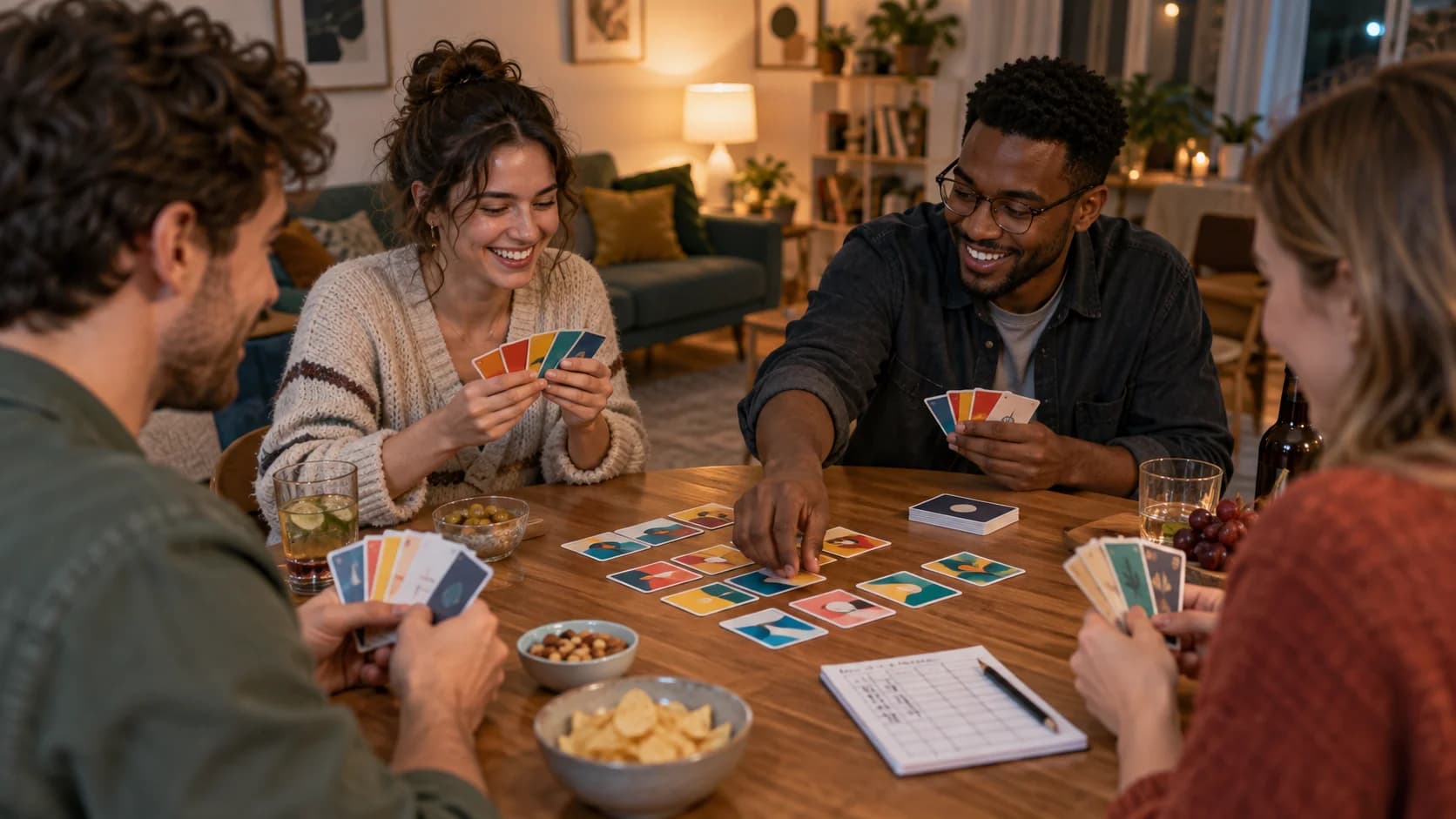
Party card games are especially strong because they turn the table into the entertainment. The cards provide prompts, constraints, roles, or sudden twists, but the fun comes from the people. That makes the format resilient. A deck can support loud groups, quiet groups, competitive players, and people who say they do not like games. The same box can feel different depending on who is playing.
Portability also changes buying behavior. A large hobby game asks for a planned evening. A card game can be an add-on purchase, a travel item, a gift, or a backup activity. That explains why publishers are making more small boxes and why retailers like card games as shelf-friendly products. When a category works for both planned play and impulse play, it gains more chances to enter everyday life.
What Trending Lists Show
Community trend lists are not the same as sales charts, but they are useful for understanding what engaged players are discussing and logging. BoardGameGeek's trending plays list in early September 2026 included recent and card-adjacent titles such as Wingspan Pocket and Marvel Champions: The Card Game BoardGameGeek trending plays. Its bestsellers page for the same period also surfaced compact and quick-play titles, including Wingspan Pocket and Flip 7 BoardGameGeek bestsellers.
The takeaway is not that every trending title is a simple party deck. It is that smaller-format games can sit beside heavier hobby releases in attention and purchase behavior. For a blog covering games, that creates a strong editorial lane: explain what a game does quickly, who it suits, what kind of group will enjoy it, and whether the replay value comes from strategy, chaos, creativity, or social deduction.
How To Choose A Card Game
The most useful buying question is not whether a game is popular. It is whether it fits the room. For families, look for clear turns, low reading load, and forgiving rounds. For adult parties, look for humor, bluffing, or conversation prompts that do not depend on inside jokes. For two players, avoid games that only become interesting at higher counts. For travel, check whether the game needs a large table or many components.
Replay value is another key signal. Some card games are funny once and fade quickly. Others create different decisions because cards combine in unpredictable ways, players learn each other's habits, or the game includes modular rules. Reviews should explain that difference plainly. A reader does not need hype. They need to know whether the box will still come out after the first weekend.
Why Digital Sites Should Cover Tabletop
A modern entertainment site should cover card games because they sit at the intersection of gaming, shopping, culture, and social life. They are not only products. They are excuses for people to gather. That makes them useful for gift guides, holiday content, family entertainment coverage, college guides, date-night ideas, and gaming trend analysis. A strong card-game article can also earn evergreen search traffic because many queries are intent-rich: best card games for groups, easy card games for adults, travel card games, family card games, and two-player card games.
The category also creates opportunities for internal linking. A card-game trend piece can link to board-game guides, gift guides, party ideas, family entertainment articles, and game reviews. That helps readers continue browsing while strengthening topical clusters for search. The Daily Unfold can treat card games as a recurring lane rather than a one-off novelty.
Bottom Line
Card games are winning in 2026 because the format respects modern attention. The best ones are fast to teach, easy to carry, affordable to buy, and flexible enough to work with different groups. They provide shared stories without needing a console, subscription, or long setup time.
For readers, the smartest approach is to buy for the group, not the trend. Choose a quick party deck for mixed crowds, a tighter strategy card game for repeat players, and a compact travel game for low-commitment fun. The card-game boom is not just about what is new. It is about what people will actually play again.
Sources
- Exploding Kittens Unleashes 10 New Games This Summer
GlobeNewswire / Exploding Kittens | Published | Checked
- Exploding Kittens Games Catalog
Exploding Kittens | Checked
- BoardGameGeek Trending Plays
BoardGameGeek | Checked
- BoardGameGeek Bestsellers
BoardGameGeek | Checked
- Playing Cards And Board Games Market Size Report
Grand View Research | Checked
Editorial disclosure
This independent card-games trend article was written in Codex for editorial review using cited publisher, marketplace, and board-game trend sources. It is not sponsored by any game publisher.