The Short Answer
Daily games are one of the stickiest entertainment formats in 2026 because they respect attention. A good daily puzzle gives players a compact challenge, a clean ending, and a reason to come back tomorrow. It does not demand a console, a long session, or a major time commitment. It fits into coffee breaks, commutes, lunch lines, group chats, and bedtime routines.
The New York Times has become the clearest example of the model. In its 2025 annual filing, the company described Wordle and Connections as daily digital word games that it makes free as part of a broader audience and subscription strategy New York Times 2025 Form 10-K. Its games subscription includes The Crossword, Mini Crossword, Wordle, Connections, Spelling Bee, and other puzzles NYT Games subscription help. The lesson is bigger than one publisher: small, repeatable games can become daily media habits.
Why The Daily Limit Works
A daily limit creates rhythm. When a puzzle appears once a day, players do not have to decide how long to play. The product makes that decision for them. That restraint can make the experience feel healthier and more valuable. The player gets a small mental workout, a result, and an invitation to return later. In an internet built for endless scrolling, an ending can feel surprisingly premium.
This format also creates shared timing. If everyone receives the same daily challenge, the puzzle becomes a social object. People compare streaks, complain about hard clues, trade hints, and post spoiler-safe result grids. The value is not only the game mechanic. It is the feeling of solving alongside other people without needing a live multiplayer lobby.
NYT Turned Puzzles Into A Product Ecosystem
The Times filing shows how games fit into a broader subscription strategy. The company said it ended 2025 with about 12.78 million total subscribers and aimed to reach 15 million by the end of 2027 New York Times 2025 Form 10-K. Games are not only a side feature in that plan. They are one of the interest-specific products that help make a bundle feel useful beyond news.
This is important for anyone building a media site. Daily games can create habit before purchase. A reader may arrive for a free puzzle, return for a streak, try another game, then eventually subscribe for archives, stats, or extra features. That funnel works because it starts with utility and delight rather than a hard sell.
Word, Logic, And Number Games Are Converging
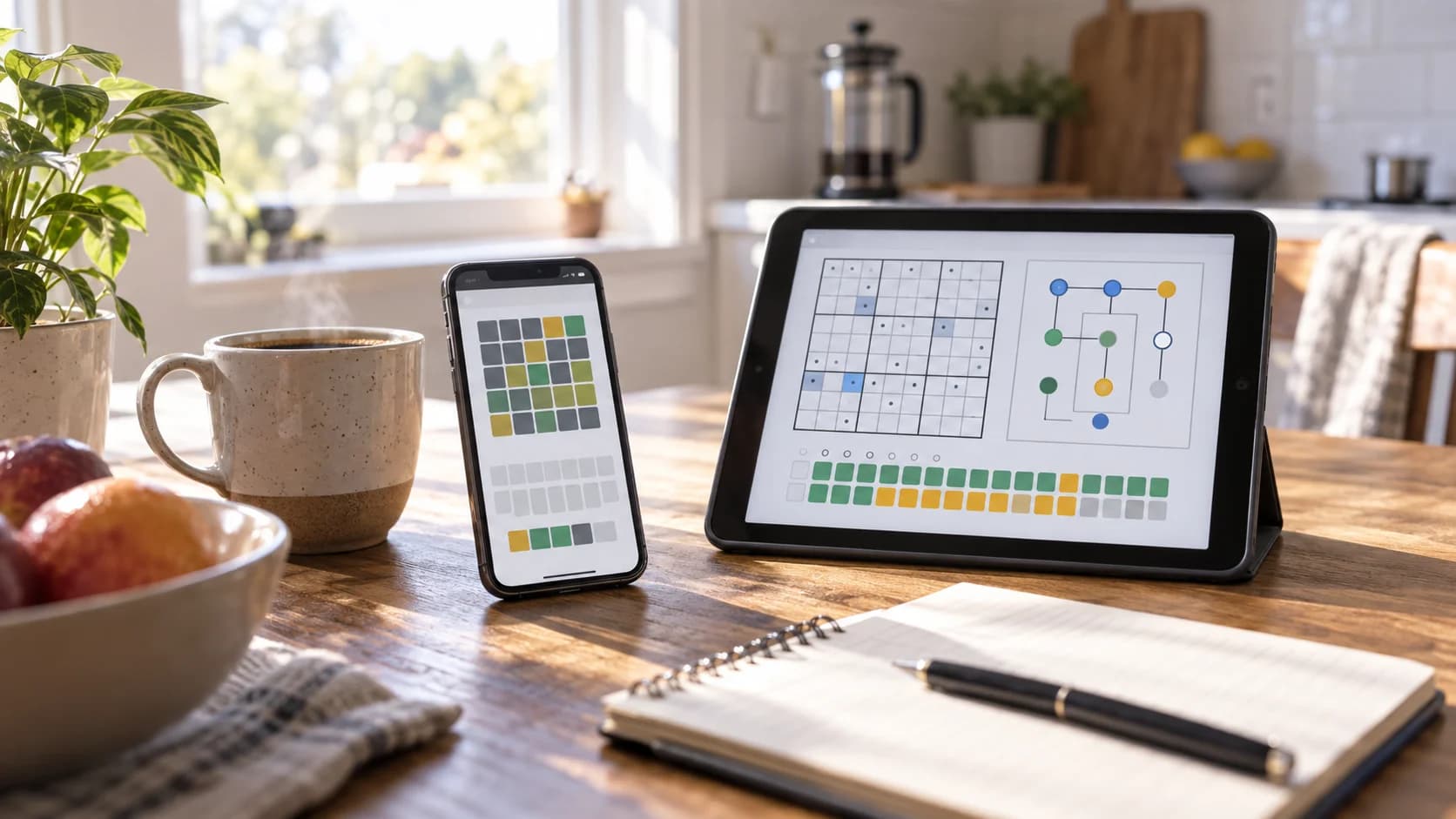
Daily games are no longer only crosswords. The Times help center lists word, logic, number, and archive-based experiences across its Games section, including Wordle, Connections, Strands, Sudoku, Tiles, Letter Boxed, and Pips NYT Games help center. That variety matters because different players want different kinds of friction.
A word game rewards vocabulary and associations. A logic puzzle rewards constraints and deduction. A number puzzle rewards patience and structure. A mini crossword rewards clue sense and speed. Putting them together lets a daily-games hub serve multiple moods while still keeping the overall routine compact.
Pips Shows The Expansion Path
Pips is a useful example of how the daily-game category can expand. A 2025 New York Times announcement described Pips as the company’s first original logic puzzle, built around arranging dominoes on a board to satisfy conditions such as equal values, unequal values, greater-than, less-than, or sums Pips announcement. That is a different mental mode from word association, but it still fits the daily habit.
The broader lesson is that daily games do not need to copy Wordle or Connections to work. They need a clear rule set, a satisfying difficulty curve, a shareable result, and a reason to return. A puzzle can be visual, numeric, linguistic, spatial, or social. What matters is that players can understand the promise quickly.
Stats And Streaks Add Motivation
Daily games become stronger when players can see progress. The NYT Games app help page describes profile features, statistics, streaks, and friend leaderboards for games including Mini Crossword, Spelling Bee, Wordle, and Connections NYT Games app help. These systems make a small puzzle feel like part of a longer personal record.
The trick is balance. Streaks can motivate, but they can also create pressure. The healthiest daily-game design keeps the puzzle enjoyable even after a streak breaks. Players should feel invited back, not punished into returning. That matters for long-term loyalty because resentment is a poor retention strategy.
What Makes A Daily Game Good
A strong daily game has five qualities. It is understandable in one minute, finishable in a short session, hard enough to feel earned, fair enough to avoid bitterness, and social enough to spark conversation. It should also work beautifully on mobile because many daily-game sessions happen in small gaps of time.
The best daily games also have editorial taste. A puzzle can be generated by systems, but players feel the difference when clues, word lists, categories, or constraints have been shaped carefully. Good curation creates trust. If players believe the puzzle is fair, they will forgive a difficult day. If they believe it is arbitrary, they will drift away.
What Publishers Can Learn
Publishers should not treat daily games as decoration. A daily game can become a front door, a retention tool, a newsletter anchor, a community ritual, and a subscription pathway. But it has to be maintained like editorial product, not thrown onto a site as a novelty. The puzzle needs quality control, archives, accessibility, clear rules, and a reason for people to talk about it.
For The Daily Unfold, the category creates two opportunities. The site can cover daily-game culture through guides, comparisons, and strategy articles. It can also build original small games that fit the same habit loop: quick to play, easy to share, and polished enough to revisit.
Bottom Line
Daily games are big because they are small. They give people a focused ritual in a noisy media environment, and they turn a few minutes of play into a recurring relationship. In 2026, that makes them one of the most valuable formats in casual digital entertainment.
The winning formula is not mystery. Make the game clear, finite, fair, social, and worth returning to tomorrow. That is why daily puzzles keep showing up in screenshots, group chats, subscription bundles, and morning routines.
Sources
- The New York Times Company 2025 Form 10-K
U.S. Securities and Exchange Commission | Published | Checked
- New York Times Games Subscription
The New York Times Help Center | Checked
- New York Times Games
The New York Times Help Center | Checked
- Introducing Pips, a new logic game from New York Times Games
The New York Times Company via Public | Published | Checked
- The New York Times Games app
The New York Times Help Center | Checked
Editorial disclosure
This independent daily-games trend article was written in Codex for editorial review using cited public filings and help resources. It is not affiliated with The New York Times or any game publisher.