The Short Answer
Education in 2026 has a new practical question: how can students use AI without outsourcing the learning that school is supposed to build? The answer is not a simple ban or a free-for-all. AI can help students brainstorm, practice, summarize, translate, plan revision, and ask better questions. It can also weaken learning if it replaces reading, writing, memory, problem-solving, discussion, and feedback. The difference is whether the student remains the thinker.
UNESCO’s guidance on generative AI in education argues that schools need human-centered rules, age-appropriate use, teacher capacity, privacy protection, and attention to inclusion rather than rushing tools into classrooms UNESCO guidance for generative AI in education. UNESCO has also published AI competency frameworks for teachers and students, framing AI literacy as something that includes ethics, human agency, system understanding, and responsible use UNESCO AI competency frameworks. For families and students, that means the goal is not simply using AI more. It is using it better.
AI Can Help Study, But It Cannot Learn For You
AI is useful when it gives students more chances to practice. It can turn notes into quiz questions, explain a concept in simpler words, suggest a study plan, or help compare two ideas. It can also act like a patient practice partner when a student is stuck. That makes it especially valuable for revision, language learning, and early drafting.
The danger starts when AI becomes the first and final answer. If a student asks for an essay, copies the structure, accepts the claims, and submits the result, very little learning happens. The student may receive a finished document, but they have not built the mental pathway that helps them write the next one. Good AI use should leave the student more capable after the session.
The Best Use Is A Tutor Mode
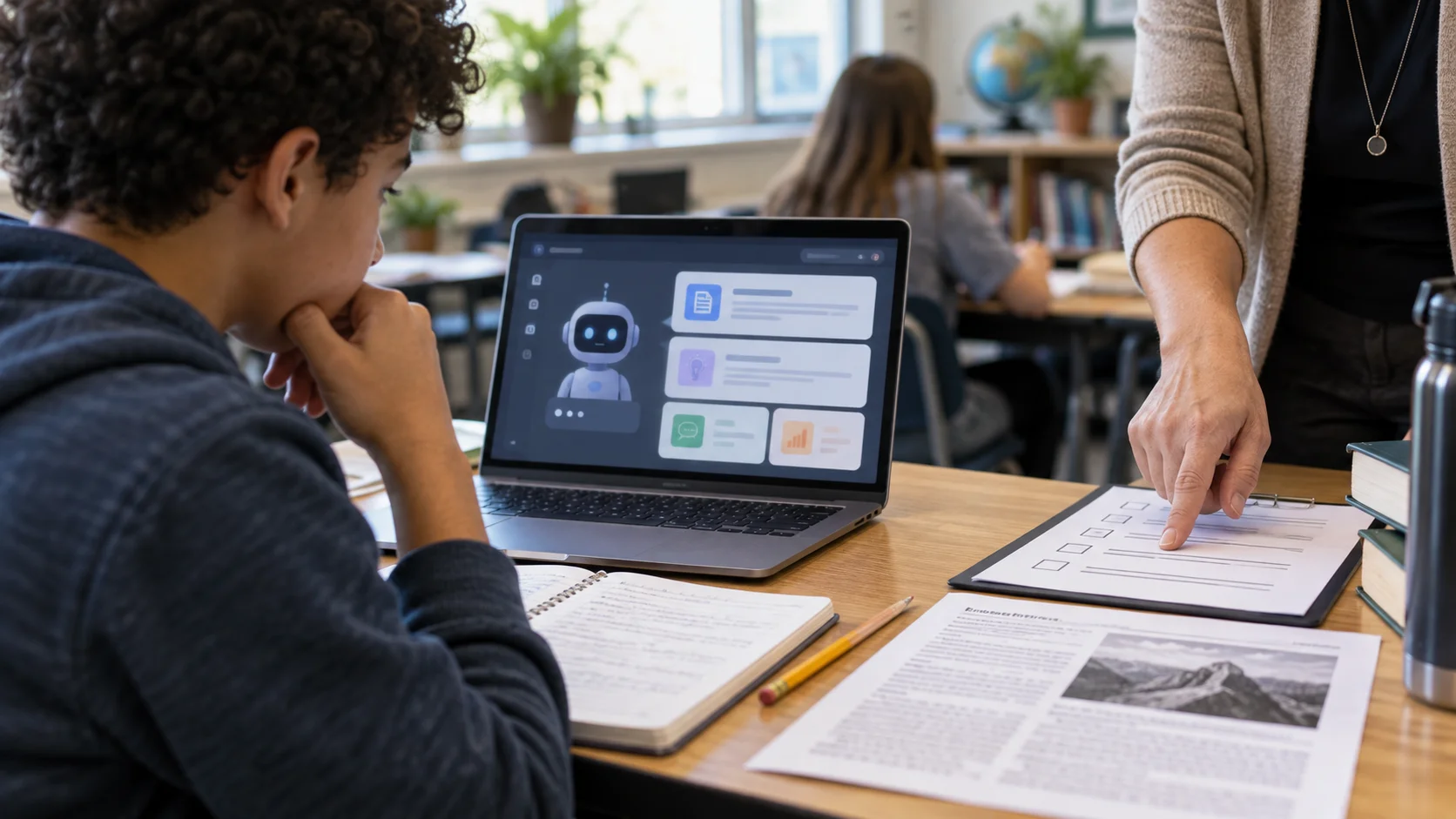
The strongest student use case is tutor mode. Instead of asking AI to do the work, students can ask it to ask questions, explain mistakes, give examples, or create practice problems. For example, a student can paste their own paragraph and ask what is unclear, or ask for three questions that test whether they understood a science concept. The work remains theirs, but the feedback loop becomes faster.
This approach also fits the broader direction of AI literacy. UNESCO’s student competency framework emphasizes a human-centered mindset, ethics, AI techniques, system design, and practical use UNESCO AI competency frameworks. Those are not only technical skills. They are habits of judgment. Students need to know when an AI answer is useful, when it is shallow, and when it should be checked against a better source.
Source Checking Is A Core Skill
Students should treat AI answers as starting points, not sources. A chatbot can produce confident text that sounds polished while still being wrong, outdated, or missing context. That is why source checking belongs inside the study process. If an answer makes a factual claim, students should trace it to textbooks, teacher materials, academic sources, official statistics, or primary documents.
This habit is not just about avoiding mistakes. It strengthens understanding. When students compare an AI summary with the original reading, they see what was simplified, skipped, or distorted. That makes them better readers and better writers. It also prepares them for workplaces where AI may be common but accountability still belongs to people.
Teachers Need Clear Rules
Students cannot follow invisible expectations. A class should define what AI use is allowed, what must be disclosed, what counts as cheating, and which assignments are meant to be AI-free practice. The same tool might be acceptable for brainstorming a topic but unacceptable for writing a final reflection. Without clear rules, students may guess wrong or assume every shortcut is permitted.
UNESCO’s teacher competency framework treats teacher capacity as central to responsible AI use, including human-centered values, ethics, pedagogy, professional learning, and system understanding UNESCO AI competency frameworks. That matters because teachers are not just policing AI. They are redesigning assignments so students still practice thinking.
Reading And Writing Still Matter
AI makes reading and writing more important, not less. If a student cannot read carefully, they cannot judge an AI summary. If they cannot write clearly, they cannot shape AI-assisted notes into a useful argument. If they cannot explain their reasoning out loud, they may not understand what they submitted. These old skills become the control layer for new tools.
A practical rule is to keep at least one stage human-only. Read the source yourself before asking for a summary. Draft a rough paragraph before asking for feedback. Solve a math problem before asking where you went wrong. Try a translation before comparing alternatives. That preserves the productive struggle that builds learning.
Parents Can Ask Better Questions
Parents do not need to become AI experts overnight. They can ask simple questions that reveal whether AI is supporting or replacing learning. Did you read the assignment before using the tool? What did the AI get wrong? Which parts are your own thinking? Did your teacher allow this use? Can you explain the answer without looking at the screen?
Those questions shift the focus from punishment to understanding. A student who can explain their process is more likely to be learning. A student who cannot describe what changed between their draft and the AI output may need a reset. Families can also agree that AI is not used for private personal data, login credentials, classmates’ information, or anything the school prohibits.
What Good Assignments Look Like
AI-resilient assignments ask students to show process. Teachers can require source notes, oral explanations, reflection on revisions, in-class writing, local observations, personal reasoning, or comparisons between sources. They can also ask students to critique AI output rather than pretend it does not exist. That teaches both subject knowledge and digital judgment.
The goal is not making cheating impossible. The goal is making learning visible. When students show how they reached an answer, teachers can support the skills underneath the grade. AI should not erase the pathway between confusion and understanding. It should help make that pathway clearer.
Bottom Line
AI is now part of education, but it should not become the author of a student’s thinking. The best use is active: ask for practice, feedback, questions, examples, and checks. The weakest use is passive: accept a polished answer without reading, writing, or verifying.
Students who learn to use AI responsibly may gain a real advantage. Not because they can finish homework faster, but because they can ask better questions, check claims, revise more thoughtfully, and keep ownership of their learning.
Sources
- Guidance for Generative AI in Education and Research
UNESCO | Published | Checked
- AI Competency Frameworks for Teachers and Students
UNESCO | Checked
- Digital Education Outlook 2023
OECD | Published | Checked
Editorial disclosure
This independent education article was written in Codex for editorial review using cited education and digital learning sources. It is general information, not advice for a specific school policy.