The Short Answer
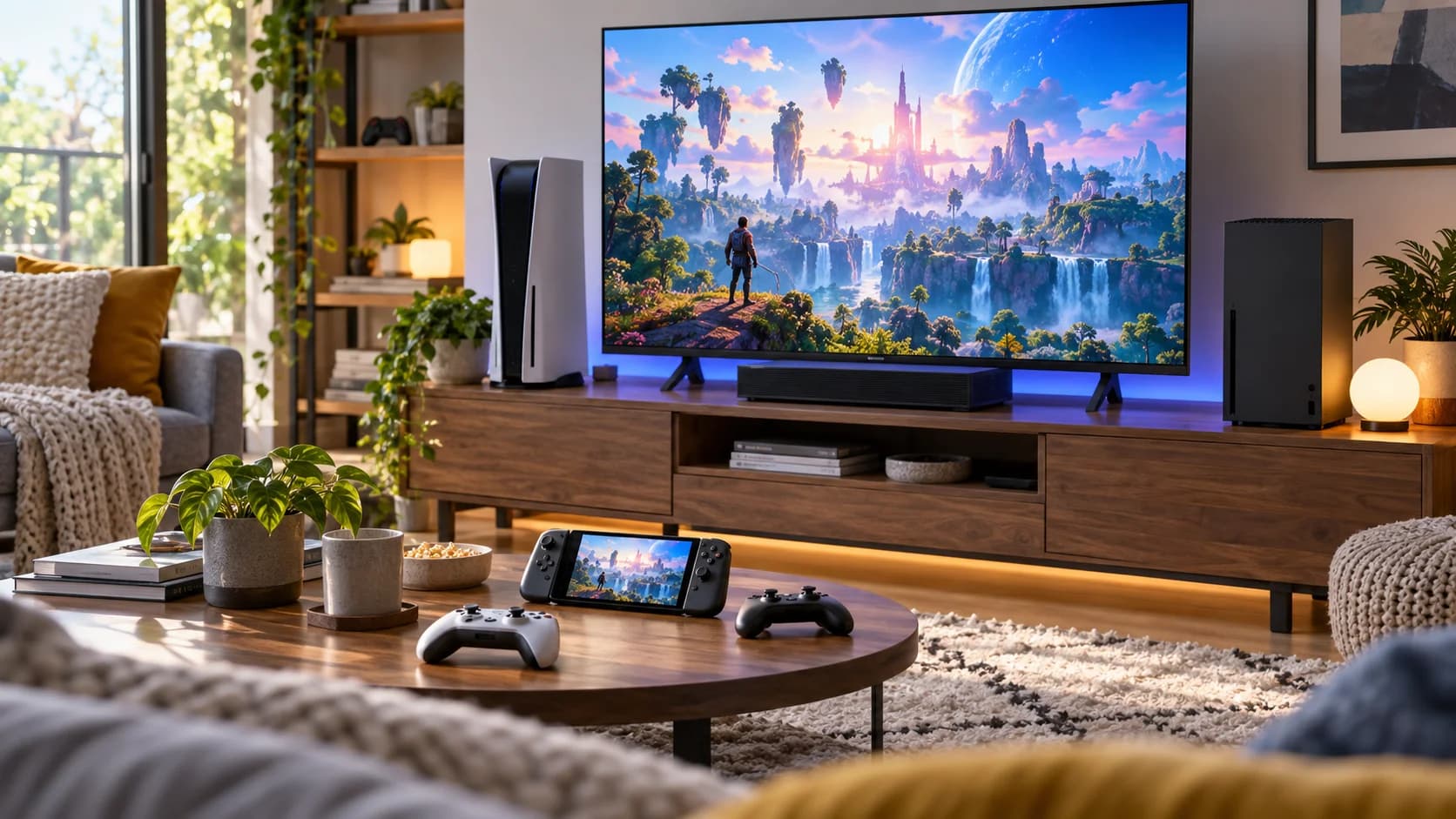
The best gaming console in 2026 depends on three questions: where do you play, what games do you care about, and how much do subscriptions matter? Living-room consoles still deliver the strongest big-screen experience, but handheld and hybrid systems have changed expectations. Players now want flexibility, family-friendly local play, cloud saves, portable sessions, and libraries that follow them across devices.
Nintendo made the hybrid conversation louder when it launched Nintendo Switch 2 on June 5, 2025, with a larger display, magnetic Joy-Con 2 controllers, GameChat, backward compatibility for many Nintendo Switch games, and a new Mario Kart World title at launch Nintendo Switch 2 launch announcement. Sony’s PlayStation 5 remains a major home-console platform, while Microsoft continues to position Xbox around console hardware, PC, cloud, and Game Pass. In 2026, the console decision is no longer only about the box under the TV.
Start With The Household
A console is usually a household decision, not only a spec decision. A family may care about local multiplayer, parental controls, party games, durable controllers, and easy setup. A college student may care about portability and dorm-room space. A competitive player may care about performance, headset support, controller latency, and online services. A single-player fan may care most about exclusives and story-driven releases.
This is why the best console for one person can be frustrating for another. If the main TV is always occupied, a hybrid or handheld-friendly system becomes more valuable. If everyone plays on the couch together, local multiplayer and simple controller pairing matter. If your friends are already on one platform, switching may cost more than the console price because social libraries and multiplayer habits are sticky.
Power Is Not Everything
Performance still matters, especially for players who care about 4K output, high frame rates, advanced graphics, racing games, shooters, sports titles, and cinematic releases. But power is not the only measure of value. Many of the most-played games are not the most technically demanding. Comfort, library, price, online service quality, storage, controller feel, and backwards compatibility can affect everyday satisfaction more than a benchmark.
Nintendo’s Switch 2 messaging leaned into upgraded hardware while preserving hybrid play and compatibility with many existing Switch games Nintendo Switch 2 launch announcement. That illustrates the modern console tradeoff: a system can win by fitting more moments, not simply by being the strongest machine.
Subscriptions Change The Math
Subscriptions make console shopping more complicated. A cheaper console may become more expensive over time if online play, cloud saves, or game libraries require recurring payments. A pricier system may feel better value if the subscription includes games the household actually plays. The important thing is to price the first year, not only the hardware.
Microsoft has made subscriptions central to its gaming strategy through Xbox Game Pass, which spans console, PC, and cloud options Xbox Game Pass. Sony offers PlayStation Plus tiers that include online multiplayer, monthly games, catalog access depending on plan, and cloud features PlayStation Plus. Nintendo Switch Online offers online play, cloud saves for compatible games, classic game libraries, and expansion options Nintendo Switch Online. Buyers should compare the games they will actually use, not just the number in the catalog.
Storage Is A Hidden Cost
Digital games are convenient, but they can consume storage quickly. Some major games require large downloads, updates, and extra content. If you buy mostly digital games, storage expansion may become part of the real console price. Physical discs or cartridges can help, but many games still need updates, and some physical releases include only part of the full content.
Before buying, check the storage expansion method and price. Some systems use proprietary expansion cards, while others support standard drives under specific requirements. If a console will be shared by multiple players, storage pressure appears faster. A household with sports, shooters, racing games, and open-world titles may fill a drive much sooner than expected.
Exclusive Games Still Matter
Exclusive games remain one of the strongest reasons to choose a platform. A console with weaker specs can still be the right choice if it has the games you play most. Nintendo’s first-party library, PlayStation’s cinematic single-player portfolio, and Xbox’s subscription and PC-connected ecosystem each serve different habits. The wrong platform is the one that makes you admire games you never actually play.
The best approach is to make a list of five games you or your household care about most. Then check where they are available, whether cross-play exists, whether friends play there, and whether subscriptions are needed. That list will usually tell you more than a spec comparison chart.
Parents Should Check Controls Early
For families, parental controls should be part of the buying decision. Check whether the console supports spending limits, age ratings, play-time settings, friend requests, voice chat controls, privacy settings, and account separation. These settings are much easier to configure before the console becomes the center of the living room.
It also helps to decide family rules before setup: where the console lives, when online chat is allowed, who can buy games, what happens on school nights, and whether handheld play is allowed in bedrooms. The hardware is only part of the system. The household rules make it livable.
Upgrade Timing Matters
Console upgrades are easiest to justify when the current system no longer supports the games people actually want to play. If a household already has a large library and everyone is happy, waiting can be sensible. Prices, bundles, storage options, and game libraries often improve after the first wave of hardware excitement. A launch window is exciting, but it is not always the best value window.
On the other hand, waiting too long can create its own frustration. Online communities move, new releases may skip older hardware, and kids may want the platform their friends use. The practical upgrade test is simple: list the games that require the new console, the people who will play them, and the total cost including controllers, subscription, storage, and protection plans. If the list is thin, the upgrade can wait.
Bottom Line
Gaming consoles in 2026 are not a simple power ranking. The right console depends on portability, TV access, family needs, exclusive games, subscriptions, storage, and where friends play. A powerful system can be the wrong buy if it does not fit the household. A hybrid system can be better value if it gets used more often.
The smartest buying order is clear: choose the games, choose the play style, price the first year including subscriptions and storage, then pick the hardware. Consoles are entertainment machines, but the best one is the one people actually turn on.
Sources
- Nintendo Switch 2 Launches June 5, 2025
Nintendo | Published | Checked
- Xbox Game Pass
Xbox | Checked
- PlayStation Plus
PlayStation | Checked
- Nintendo Switch Online
Nintendo | Checked
Editorial disclosure
This independent gaming-console buying guide was written in Codex for editorial review using cited platform and market sources. It is not sponsored by any console maker.