Start with the claim, not the confidence
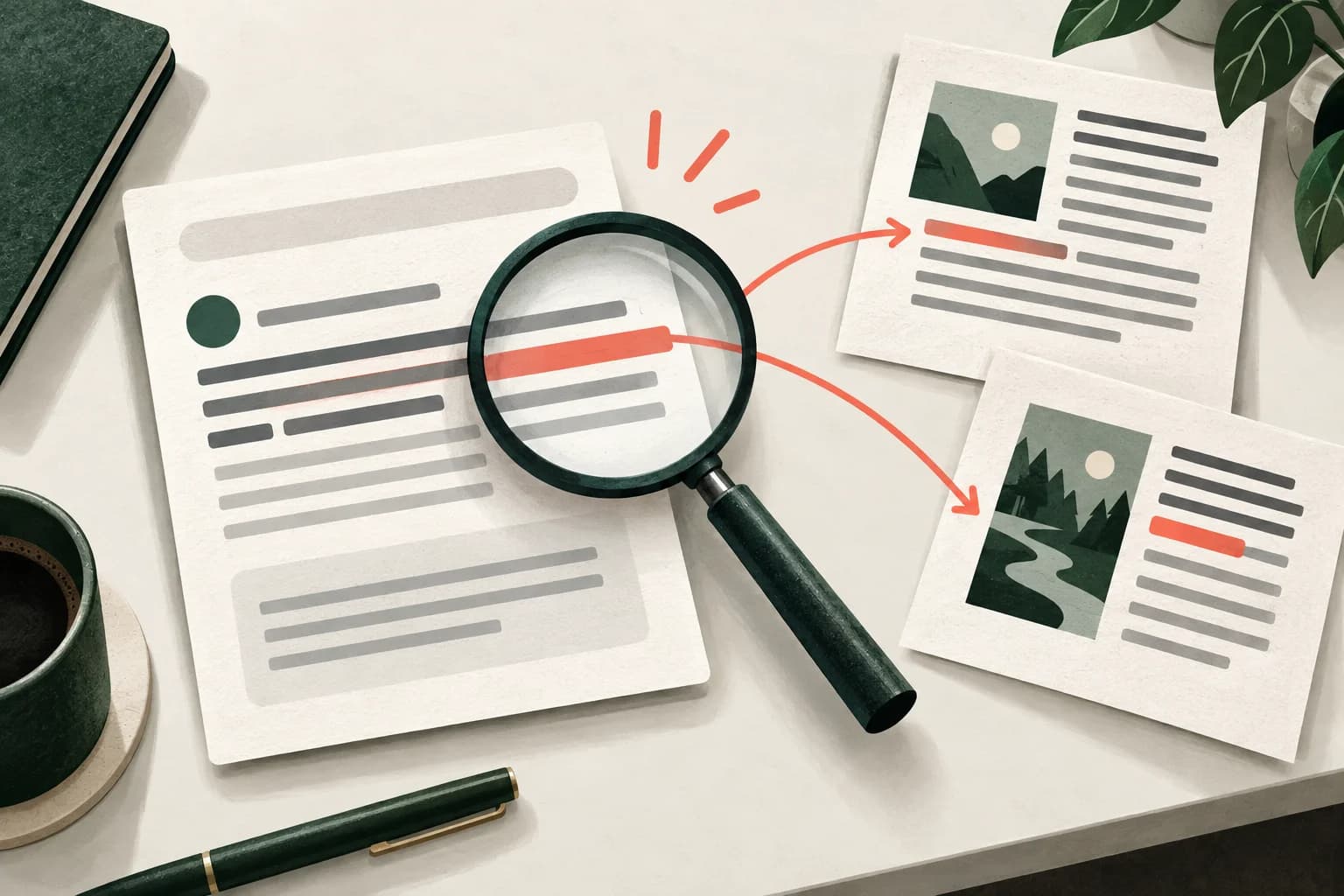
To check an AI Mode answer, pick the statement that matters to your decision, open its supporting source, and compare what the source actually says with the answer. Check whether the date, place, and conditions match your question. When the evidence is missing or contradictory, keep the conclusion open rather than treating a confident sentence as confirmation.
Google describes AI Mode as an experience that supports follow-up questions and links to the web, while warning that responses can contain mistakes. That makes the distinction between an answer and its evidence worth keeping in view. A fluent summary can help you decide what to investigate; it should not decide, by itself, when your investigation is finished. Google AI Mode Help
The workflow below is designed for everyday research: checking an event detail, understanding an announcement, or evaluating a product claim. It is not an accuracy benchmark, and we have not conducted a live comparison of AI Mode responses for this article. The worked example is deliberately fictional so you can concentrate on the checking process.
Turn a broad answer into a specific question
An answer might combine several kinds of information in one paragraph: an opening time, a recommendation, a prediction, and a description. Separate them. Start with a statement you could reasonably confirm or disprove, such as whether a venue is open on the date you intend to visit. A recommendation about whether you will enjoy it needs a different kind of judgment.
Write the claim in one sentence before opening another tab. Include qualifiers that could change the answer: the location, product version, date, account type, or intended activity. If you cannot tell what a sentence refers to, ask a narrower question. A useful verification question has boundaries; it should not require you to prove that an entire answer is universally correct.
Follow the reference to the actual evidence
Google's May 6, 2026 announcement described changes intended to make relevant websites and original material easier to explore from its AI search features. Easier access to links is useful, but it does not remove the reader's next job: checking whether the linked material supports the particular claim being made. Treat that announcement as dated product context, not a guarantee of the interface you will see. Google's source-link announcement
Open the relevant page and locate the passage behind the statement. Do not stop at a headline or a search snippet. Read the surrounding paragraph, notes, and any qualification that changes its meaning. Ask whether you have found direct support, background information, or simply another page discussing the same subject. Those are different outcomes, even when all three pages look relevant.
For an organization's own opening hours, its current visitor-information page is a sensible starting point. For a claim about the quality of its service, that organization's marketing page may tell you what it promises without independently demonstrating the promise. Choose evidence according to the question rather than assuming that one kind of source is best for every purpose.
Check the date and the conditions together
A page can be accurate and still be wrong for your situation. Before carrying a detail into your plans, check whether it applies to the right day, place, version, or group of people. A general timetable does not settle a holiday exception. An announcement about a planned launch does not establish that a feature is available in your country today.
Look for the date of the event or change as well as the page's publication or update date. They answer different questions. If an article was updated recently, look for evidence that the specific detail you need was updated too. When the distinction remains unclear, record the uncertainty or consult a more direct source instead of silently assuming the newest-looking page wins.
Ask whether the evidence is genuinely independent
Mike Caulfield's SIFT framework offers useful context for this habit: pause, investigate who is behind a source, look for better coverage, and trace a claim to its original setting. The point is not to award trust based on visual polish. It is to understand who is speaking and what supports the statement before deciding how to use it. SIFT, by Mike Caulfield
When several pages repeat a claim, trace their references before counting them as separate confirmation. If each points to the same announcement, you have found several reports of one source. That can establish what was announced, but it does not automatically establish that the promised outcome occurred. Seek a different kind of evidence when the question requires it, such as a current operational notice or a clearly described independent test.
Apply the same distinction to repeated AI answers. Asking another assistant, or phrasing the question differently, can suggest useful leads. Agreement between the resulting answers is not a substitute for checking their evidence. If they point back to the same material, repetition has not supplied the missing verification.
A fictional example: will the museum be open?
Imagine you are planning a Monday visit to a fictional venue called Example Museum. A hypothetical AI answer says it opens at 9 a.m. This is an invented teaching scenario, not a report of an actual Google response or a real venue's hours. Your checkable claim is narrow: can you enter that museum at 9 a.m. on the particular Monday you have chosen?
Suppose the answer points to an old city guide, whose timetable does list a 9 a.m. opening. You have now found the likely origin of the claim, but not confirmation that it applies to your visit. Next, imagine that the museum's own current visitor page says it is usually closed on Mondays. That introduces a conflict; it is a reason to investigate further, not to average the two answers.
Finally, suppose a dated notice on the same official site announces a special opening at 10 a.m. on your chosen Monday. Check that it names the right branch and date, and that there is no newer cancellation. Your useful conclusion would then be tied to that notice: the fictional special opening is scheduled for 10 a.m., subject to any later changes. The older guide did not answer your actual question.
Notice what this exercise did not require: deciding whether AI search is good or bad as a whole. You followed one claim through its evidence and found the condition that mattered. That is a more practical outcome than accepting an entire answer, or rejecting it entirely, because of how convincingly it was written.
What if the source is missing or inaccessible?
If you cannot inspect a cited page, say so in your own notes. An inaccessible source does not automatically make the claim false, but it leaves you unable to verify it through that reference. Look for a legitimate public version, an original announcement, or another accessible source that directly supports the same detail. Do not treat a snippet as a replacement for material you have not read.
If the answer provides no clear reference for the statement you care about, search for that statement independently. You can also ask for supporting sources, but check any new links yourself. A more detailed response is only a new lead. If adequate evidence remains unavailable, the honest result is that the claim is unverified, not that you must choose between certainty and total disbelief.
What if reliable-looking sources disagree?
First check whether they are actually answering the same question. Different time periods, definitions, locations, or versions can create an apparent disagreement. Write down the precise point of conflict and the scope of each source. That often makes the next research step clearer than gathering another long list of broadly related links.
If the disagreement survives that comparison, keep it visible in your conclusion. You might have enough evidence for a limited statement but not a sweeping one. For a practical detail, contacting the responsible organization may be more useful than continuing to compare summaries. For a broader question, explain which part remains disputed and avoid presenting an unresolved choice as a settled fact.
Keep a short record you can revisit
A verification note does not need to become a research project. Record the claim, the original source link, the relevant date or conditions, and your conclusion. Add the date you checked it. If the answer depends on a changing timetable or rollout, include a reminder to recheck before acting. Avoid collecting personal details or unrelated screenshots just to make the note look thorough.
Use plain labels that describe the evidence: supported for this date, supported with conditions, contradicted by the current notice, or not yet verified. These are more informative than a simple trusted or untrusted label attached to the whole answer. When sharing your conclusion, share the relevant original link and the important qualification, rather than only a screenshot of the AI summary.
Let the evidence determine when you stop
Before relying on an answer, ask yourself whether you can identify the important claim, show where its support comes from, and explain the conditions under which it applies. If you can do those things, you have something more useful than confidence borrowed from an interface. If you cannot, narrow the claim or leave the uncertainty explicit.
Not every casual question needs an exhaustive investigation. Match the effort to what you plan to do with the answer. For a time-sensitive decision, checking the current original information is worth prioritizing. For early exploration, an answer may simply provide a starting list of questions. The goal is not to distrust every summary; it is to keep the summary connected to evidence you can actually examine.
Sources
- Get AI-powered responses with AI Mode in Google Search
Google Search Help | Checked
- 5 new ways to explore the web with generative AI in Search
Google | Published | Checked
- SIFT (The Four Moves)
Mike Caulfield / Hapgood | Published | Checked
CC BY 4.0; framework credited, original application and examples by The Daily Unfold's AI-assisted draft
Editorial disclosure
Written with AI assistance in Codex. Featured image generated with the built-in image-generation tool. The museum example is fictional, not a live product test.